Cliff Richard Temple (CT-95-218)
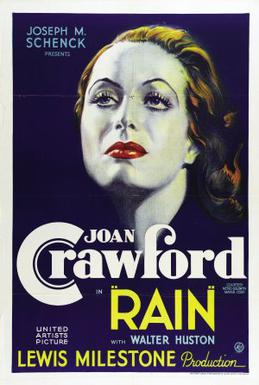
Film poster of Rain, 1932
In the late Summer of 1995, Cliff Richard Temple answered a call in the East Anglian press for volunteers to take part in Cinema Culture in 1930s Britain, eventually joining the twenty-one individuals, couples, and groups living in that region who were interviewed for the project as core informants. Born in Great Yarmouth in 1906, Mr Temple鈥檚 father was a labourer and his mother a staymaker. He had lived in Norfolk all his life, moving from Yarmouth to Norwich when he was in his twenties. On leaving school at fourteen he was apprenticed to the furniture trade, and later in life became General Manager of a furniture store. A keen photographer with an interest in local history, Mr Temple had authored a number of newspaper and magazine articles and books on Norfolk life.1 He was interviewed at his home in Norwich on 23 October and 20 November 1995.
For his interviews, Mr Temple had prepared lists of films and stars, and these are referred to sporadically throughout. In his first interview he shows his collection of cigarette cards and talks about silent films and their stars, with special mention of actors in cowboy films and childhood games of Cowboys and Indians. He notes that he was a regular cinemagoer in his teens and kept a diary of films seen鈥攊nsisting, however, that filmgoing was just one of many pastimes, his main hobbies being making model ships and photography. He names some cinemas in Great Yarmouth and Norwich and discusses several favourite stars and films, with particular reference to musicals, both film and stage. He shows the interviewer the photographs he has made of local musicals, plays, and circuses and brings out his collection of theatre programmes. Disappointed at not being paid for this interview, he nevertheless admits that he has enjoyed reliving his memories, while maintaining that he does not consider himself a film fan: film was incidental, he insists: his real love was ships. Mr Temple鈥檚 second interview opens with a conversation about his likes and dislikes: he prefers film stars to be 鈥渘ice and jolly鈥�, implies that he dislikes 鈥渃ommon鈥� voices or vulgar star personae, and is critical of the real lives of some celebrities, especially as regards sexual misbehaviour. His likes include special effects (in King Kong, for example) and Robert Donat, 鈥渁 proper gentleman鈥�. The last cinema film he saw was The Sound of Music, but he watches films on TV and 鈥渨hat I see I don鈥檛 really like鈥�. Noting once again that films are one of many pursuits, he indicates that he has a particular interest in cinematography and offers clear recollections of early experiments with Technicolor. He talks about his various hobbies and voluntary work and shows the interviewer his photographs and some items in his collection of books on cinema. On the question of whether he preferred British or American films, he opts for the former, because 鈥淵ou can understand what they鈥檙e talking about.鈥� Asked about the part cinema played in his life and how he felt after seeing a film, he eventually confesses to liking 鈥榰plifting鈥� films._________________________
1 Books by Mr Temple published around the time of his interviews include Great Yarmouth and Gorleston: A Pictorial History. Chichester: Phillimore & Co. Ltd, 1993; and North Norfolk. Stroud: Chalford,1995.
Interview transcript | Listing of cinemas, films and stars mentioned
Audio-synced interview (2 of 2)
Interview transcript | Listing of cinemas, films and stars mentioned
Documents, Memorabilia and Related Links
East Anglia home pageScan of letter (CT-95-218PL001) | Transcript
Scan of film list (CT-95-218PW001) | Transcript
Scan of film list (CT-95-218PW002) | Transcript
Photograph of Barron's Amusement Arcade (CT-95-218PH001)
Bookcovers of two of Cliff Richard Temple's books (CT-95-218PH002)
Photograph of miniature train referred to in interview (CT-95-218PH003)